
The beginner to intermediate workout transition is where long-term gym habits are built. Assess your baseline, apply progressive overload, introduce a training split, and expand your exercise selection one movement at a time. At Nitro Gym in Al Barsha and DSO, our certified trainers are here to design your intermediate programme and ensure every step forward is structured and injury-free.
How to Transition from Beginner to Intermediate in Your Gym Routine
Are you training consistently but no longer seeing the same results? That plateau is a signal your beginner to intermediate workout transition is overdue. The routines that challenged you in your first months are no longer enough stimulus for your body to keep adapting. At Nitro Gym in Al Barsha and DSO, our certified trainers guide members through exactly this shift. Here’s how to progress without the setbacks that come from moving too fast.
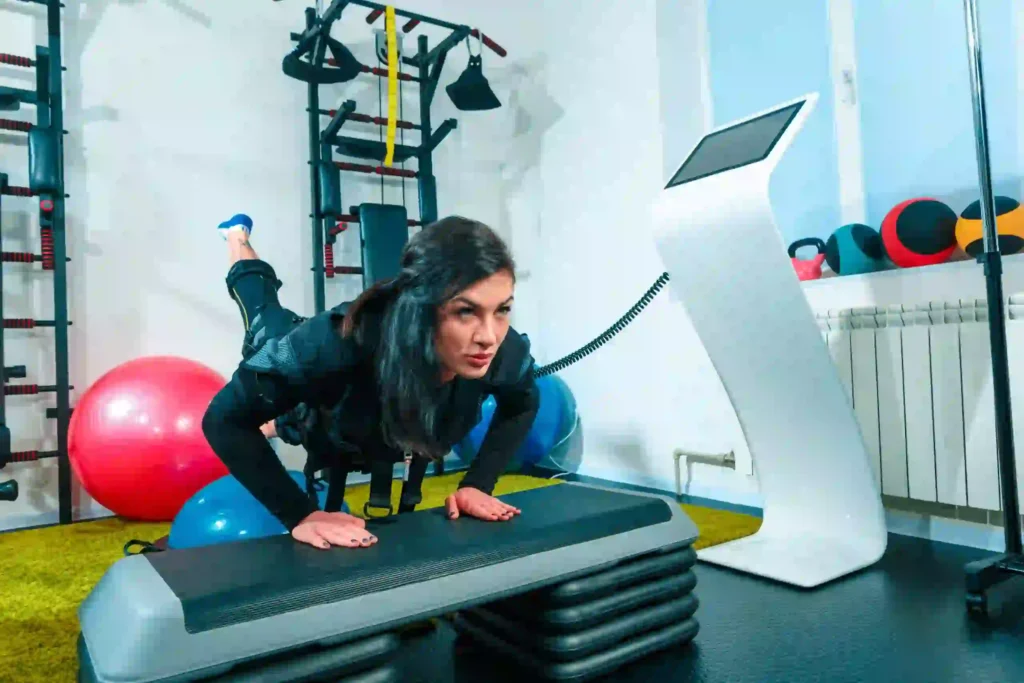
Step 1 — Assess Where You Actually Are
Before changing anything, establish a clear baseline. How to progress in the gym effectively starts with knowing your current capacity not guessing at it. Assess:
- Strength benchmarks — What weight can you lift for key compound movements (squat, deadlift, bench press, row) for 3 sets of 10 with controlled form?
- Cardiovascular capacity — How long can you sustain moderate-intensity cardio before performance noticeably drops?
- Movement quality — Can you perform the fundamental patterns (squat, hinge, push, pull, carry) through a full range of motion without compensation?
- Recovery rate — Are you recovering adequately between sessions, or are you consistently fatigued?
If you’ve been training for 3–6 months with consistent attendance and your form on the basics is solid you’re ready for intermediate fitness training. If form is still inconsistent or training frequency has been irregular, consolidate the basics before adding complexity.
Step 2 — Apply Progressive Overload Systematically
The defining principle of the beginner to intermediate workout transition is progressive overload the systematic increase of training stimulus over time. Beginners make progress almost automatically because any regular exercise is new stimulus. Intermediate trainees need to engineer progression deliberately.
Here are the primary progressive overload methods to implement:
- Load progression — Increase weight by 1–2.5kg on upper body exercises and 2.5–5kg on lower body when you can complete all programmed sets and reps with controlled form
- Volume progression — Add one additional set per exercise per week over a 4–6 week block before reducing and rebuilding
- Rep range variation — Cycle between heavier lower-rep work (4–6 reps) and moderate higher-rep work (10–15 reps) across training blocks
- Rest period reduction — Gradually reduce rest between sets from 90 seconds toward 60 seconds as conditioning improves
- Tempo manipulation — Slow the eccentric (lowering) phase of movements to 3–4 seconds to increase time under tension without adding load
- Exercise complexity — Progress from machine-based movements to free weight equivalents that require greater stabilisation and coordination
Step 3 — Structure Your Programme Around Training Splits
Beginners typically train full-body sessions 3 times per week. An intermediate workout routine introduces training splits that allow higher volume per muscle group with adequate recovery between sessions.
Effective intermediate split options:
Upper/Lower split (4 days) — Alternates upper body and lower body sessions, allowing each muscle group 48–72 hours of recovery while increasing total weekly volume.
Push/Pull/Legs (3–6 days) — Groups pushing muscles (chest, shoulders, triceps), pulling muscles (back, biceps), and legs into separate sessions. Highly effective for intermediate gym workout programming with manageable session length.
Full-body with specialisation (3 days) — Maintains full-body stimulus while emphasising a priority muscle group with additional volume each session.
Step 4 — Expand Exercise Selection Strategically
Intermediate training introduces more complex movement patterns and equipment. Workout progression for beginners often relied on machines and bodyweight movements; intermediate programming integrates more free-weight compound work alongside targeted isolation exercises.
Practical progressions to introduce:
If you were doing leg press → progress to barbell back squat or front squat If you were doing chest press machine → progress to barbell or dumbbell bench press If you were doing lat pulldown → progress to weighted pull-ups If you were doing dumbbell rows → progress to barbell rows
Introduce one new complex movement per training block, spend two to three weeks learning the technique before adding load, and always prioritise movement quality over weight.
Frequently Asked Questions
How do I know I'm ready to transition from beginner to intermediate workout?
If you've been training consistently for 3–6 months, your form on the fundamental compound movements is solid, and your progress has slowed despite consistent effort you're ready. Stalled progress on a beginner programme is the clearest signal that more advanced stimulus is needed.
How much should I increase weight when progressing to intermediate training?
For upper body movements, 1–2.5kg increments are appropriate. For lower body compound movements like squats and deadlifts, 2.5–5kg increments work well. Only increase load when you can complete all programmed sets and reps with controlled form not before.
How often should intermediate gym-goers train per week?
Four sessions per week on an upper/lower split is the most practical and evidence-supported frequency for most intermediate trainees it provides sufficient volume for adaptation while allowing adequate recovery. Advanced intermediate trainees can progress to five or six sessions using a push/pull/legs structure.