
Gym Machines vs. Free Weights: Which Is Right for You?
Should you head straight for the machines or pick up a barbell? If you’ve ever walked into a gym and felt unsure about where to start, the gym machines vs. free weights question is probably one of the first you’ve faced. The honest answer is that both have a place in a well-structured training programme, but understanding what each does best helps you make smarter choices about how to spend your time on the gym floor.
At Nitro Gym, our certified trainers at the gym in Al Barsha and gym in DSO get asked this question constantly by beginners finding their footing and experienced lifters reassessing their approach. Here’s a clear, practical breakdown.
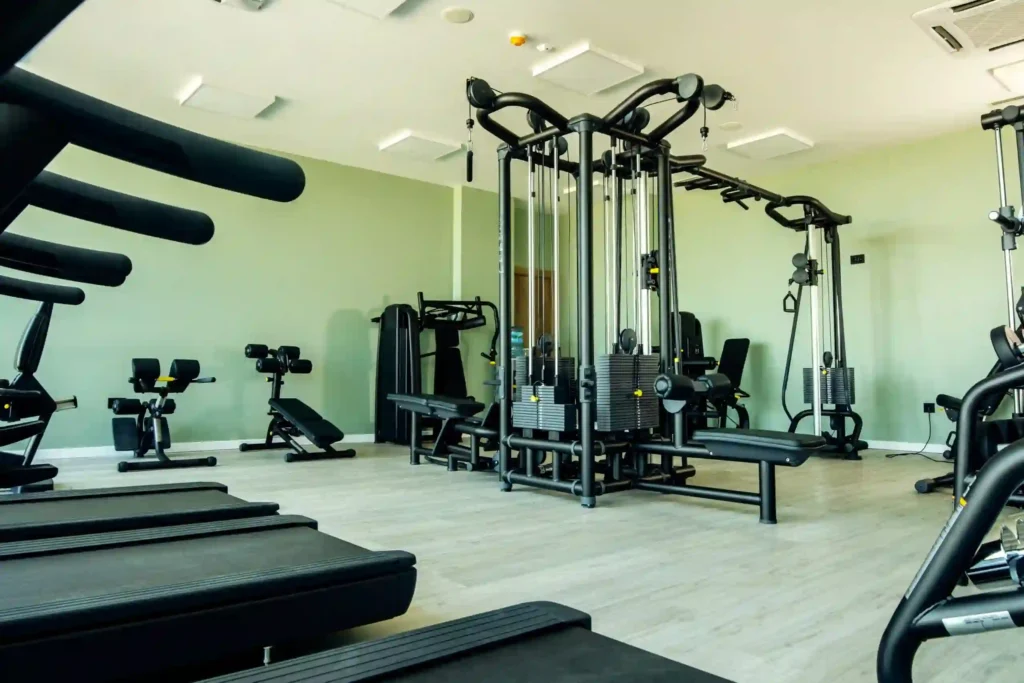
What Gym Machines Do Well
Machines are engineered to guide movement along a fixed path, which removes the balance and stabilisation demands of free weight training. This makes them particularly valuable in specific contexts.
- Beginners and technique development: For someone new to resistance training, machines provide a controlled environment to learn the basic movement patterns pressing, pulling, extending, and flexing without the technical demands of free weights. The guided range of motion reduces the risk of compensation patterns that can lead to injury.
- Injury rehabilitation: Machines allow targeted loading of a specific muscle group while minimising stress on surrounding structures. This makes them the safer choice when training around an injury or returning from one.
- Muscle isolation: When the goal is to develop a specific muscle the leg extension for the quadriceps, the cable fly for the chest, the leg curl for the hamstrings machines isolate that muscle more effectively than most free weight alternatives.
- Training efficiency: Adjusting resistance on a machine takes seconds. During high-volume training blocks or supersets, this speed advantage significantly reduces rest time and increases training density.
What Free Weights Do Better
Free weights dumbbells, barbells, kettlebells, and cables require your body to control the load through space. This demand activates a broader range of muscles simultaneously and builds strength that translates directly into real-world movement.
Here’s what makes free weights distinctly effective:
- Compound movement patterns: Squats, deadlifts, bench press, overhead press, and rows train multiple muscle groups simultaneously, producing greater hormonal response and calorie burn per exercise than most machine equivalents.
- Stabiliser muscle recruitment: Because there is no fixed path, your body must engage smaller stabilising muscles to control the movement. This builds functional strength and joint stability over time.
- Natural range of motion: Free weights allow your body to move through its natural arc rather than a machine-determined path, which better suits individual biomechanics and reduces joint stress in many movements.
- Progressive overload flexibility: Small weight increments (as low as 0.5kg) allow precise, gradual load increases that machines with fixed weight stacks often can’t match.
- Core activation: Most free weight exercises require significant core engagement to maintain posture and spinal stability under load, strengthening the trunk as a by-product of almost every session.
- Calorie expenditure: Greater muscle recruitment means higher energy demand. Free weight compound movements consistently burn more calories than their machine-based equivalents.
How to Choose Based on Your Goals
If you’re a beginner: Start with machines to build familiarity with movement patterns, develop basic strength, and build confidence on the gym floor. Introduce free weights progressively over your first 4–8 weeks.
If your goal is fat loss: Prioritise compound free weight movements squats, deadlifts, rows, and pressing for maximum calorie burn and metabolic impact. Supplement with machines for isolation work.
If your goal is muscle building (hypertrophy): A combination works best. Use compound free weight movements as the foundation of your session, then use machines to isolate and target specific muscles with controlled volume at the end of the workout.
If you’re recovering from injury: Machines are the safer starting point. Work with a qualified trainer to identify which movements are appropriate and progressively reintroduce free weights as strength and stability return.
For most gym-goers: The most effective programmes combine both. Free weights build the functional strength and hormonal response; machines add targeted volume where it’s needed.
Frequently Asked Questions
Are free weights better than machines for building muscle?
Is it safe for beginners to use free weights from day one?
Should I do machines or free weights first in my workout?
Conclusion
The gym machines vs. free weights debate doesn’t need a definitive winner. Each tool has a role, and the most effective training programmes leverage both. Free weights build the functional strength and compound movement foundation; machines add targeted isolation and training efficiency.
At Nitro Gym, whether you train at our gym in DSO or our gym in Al Barsha, you’ll find a full range of both plate-loaded machines, cable stations, free weights, and barbells alongside certified trainers who can help you build a programme that uses every tool in the right way.